Buying Guides
Future GPX Cyber Formula Model Cars: UK Guide
Written by Zero Variant · Published · Updated
Future GPX Cyber Formula first aired in 1991 and its distinctive racing machines have inspired model cars and collectibles for decades. The series follows a fictional championship for computer-assisted racing machines. Those machines are the main subject of the vehicle-model ranges covered here.
That has produced an unusually wide range of products. The same car can exist as a 70mm display model or as a die-cast piece with LED lighting, sound and a full transformation. Both are officially licensed. Neither replaces the other.
This guide covers what the machines are, which Asurada is which, how the main MegaHouse and threezero threeMega product lines differ and where to buy Cyber Formula collectibles in the UK.
To see which models you can order, shop Cyber Formula collectibles. Each product card shows the current price and availability.
What is Future GPX Cyber Formula?
The television series was produced by Sunrise and ran for 37 episodes in 1991, directed by Mitsuo Fukuda. Mechanical design came from Shoji Kawamori of Studio Nue, the designer behind the Macross Valkyries. That lineage shows in the cars: aerodynamic parts fold, deploy and change the silhouette rather than sitting still.
Four OVA series followed: 11 (Double One), ZERO, SAGA and SIN. Each moves the championship on a few years and gives the teams new machines. Products are usually labelled with the instalment their car comes from, which matters because the same driver appears in several different cars across the run.
What Asurada actually is
Asurada is not one car. It started as the artificial intelligence system built into the machine Hayato Kazami drives for the Sugo team, developed by his father. The name then carried across every later car built around it.
The family runs roughly like this. The Asurada G.S.X appears in the television series before the Asurada cyber system is transferred into the separate Super Asurada 01 chassis. The 11 OVA opens with the Super Asurada SA-01/C, a modified Super Asurada 01, before the Super Asurada AKF-11 replaces it during the same season. The ν-Asurada AKF-0 follows and becomes the ν-Asurada AKF-0/G by SIN. Hayato also spends the early part of SAGA in a different Sugo car entirely, the Garland SF-03.
These are separate designs with different proportions and different features, not repaints of one model. If a listing says Asurada, check which Asurada.
The machines collectors meet most
- Asurada G.S.X. Hayato's first Sugo machine, from the television series. Its Aero Mode is one of the configurations represented in model form.
- Super Asurada 01. The separate chassis introduced later in the television series, with Circuit, Rally and Aero modes.
- Super Asurada SA-01/C. The modified Super Asurada 01 Hayato races at the start of 11, told apart by its reshaped rear wing endplates and redesigned undertray.
- Super Asurada AKF-11. The machine that replaces the SA-01/C during 11 and carries Hayato through ZERO.
- ν-Asurada AKF-0. The SAGA-era Sugo car, continuing into SIN as the ν-Asurada AKF-0/G.
- Garland SF-03. The Sugo machine Hayato drove early in SAGA, after first stepping away from an Asurada.
- Knight Savior 005. Knight Schumacher's red and white car in the television series.
- Stealth Jaguar Z-7. Bleed Kaga's Aoi ZIP Formula machine in the television series, before the Ogre AN-21 of SIN.
- Missionel VR-4. The Missing Link machine driven by Edelhi Bootsvorz, described as the "One-Eyed Dragon" in MegaHouse's English product copy.
- Ogre AN-21. Written 凰呀 in Japanese, this is Bleed Kaga's Aoi ZIP Formula machine in SIN. Kaga drives the Stealth Jaguar Z-7 for Aoi ZIP Formula in the television series, so the two machines are easy to confuse by driver alone.
The main Cyber Formula model car lines
MegaHouse has held this licence for years and runs several parallel lines at different sizes and price points. threezero comes in through threeMega, a brand it operates jointly with MegaHouse. The groups below cover the main formats in this guide.
MegaHouse Heritage Edition
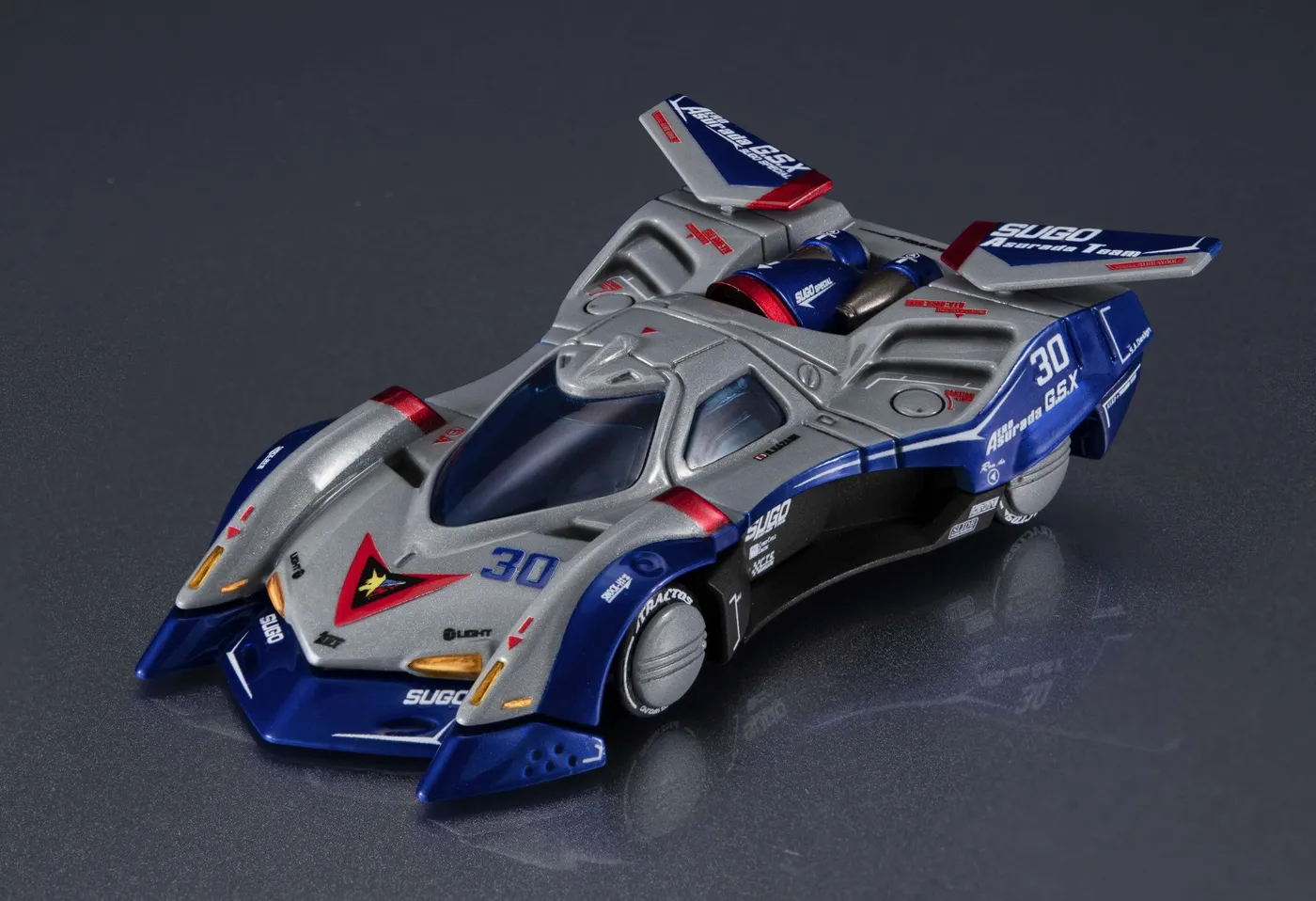
Heritage Edition sits inside MegaHouse's long-running Cyber Formula Collection, usually shortened to C.F.C. These are small pre-painted display models, generally around 70mm long. Scale labelling varies between releases, so collectors should check the individual product specifications.
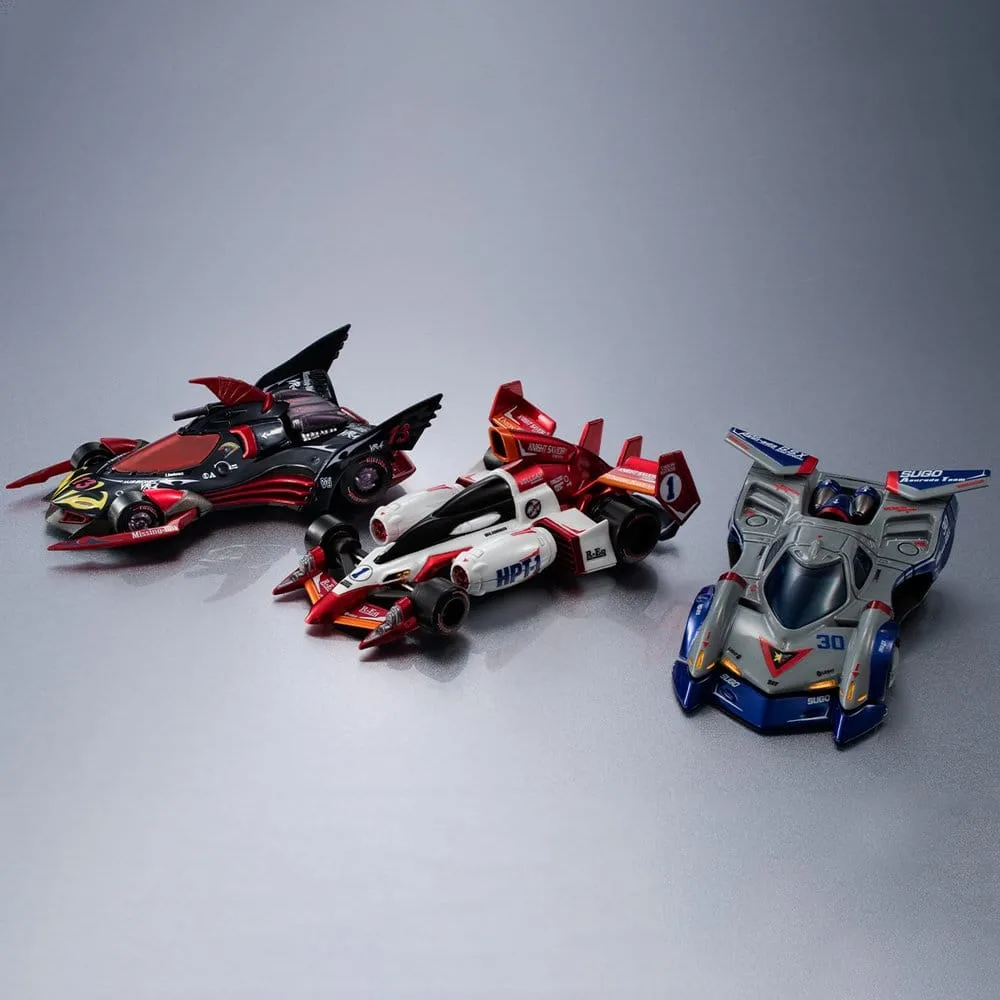
Each one ships with a clear display case that stacks vertically plus a nameplate-style foil sticker, so a group lines up like a grid with no extra work. They offer a compact entry point into these machines.
Features still vary by release. The Missionel VR-4 has articulated clawed plates behind its front tyres so it can be switched to its attack configuration, while other cars in the line are fixed display pieces. That car, the Knight Savior 005 and the Asurada G.S.X Aero Mode are each sold on their own. The three-machine Heritage Edition set brings all three together in one box. A Proto Jaguar Z-6 and Aoi Stealth Jaguar Z-7 two-pack covers the Jaguar machines in the same format.
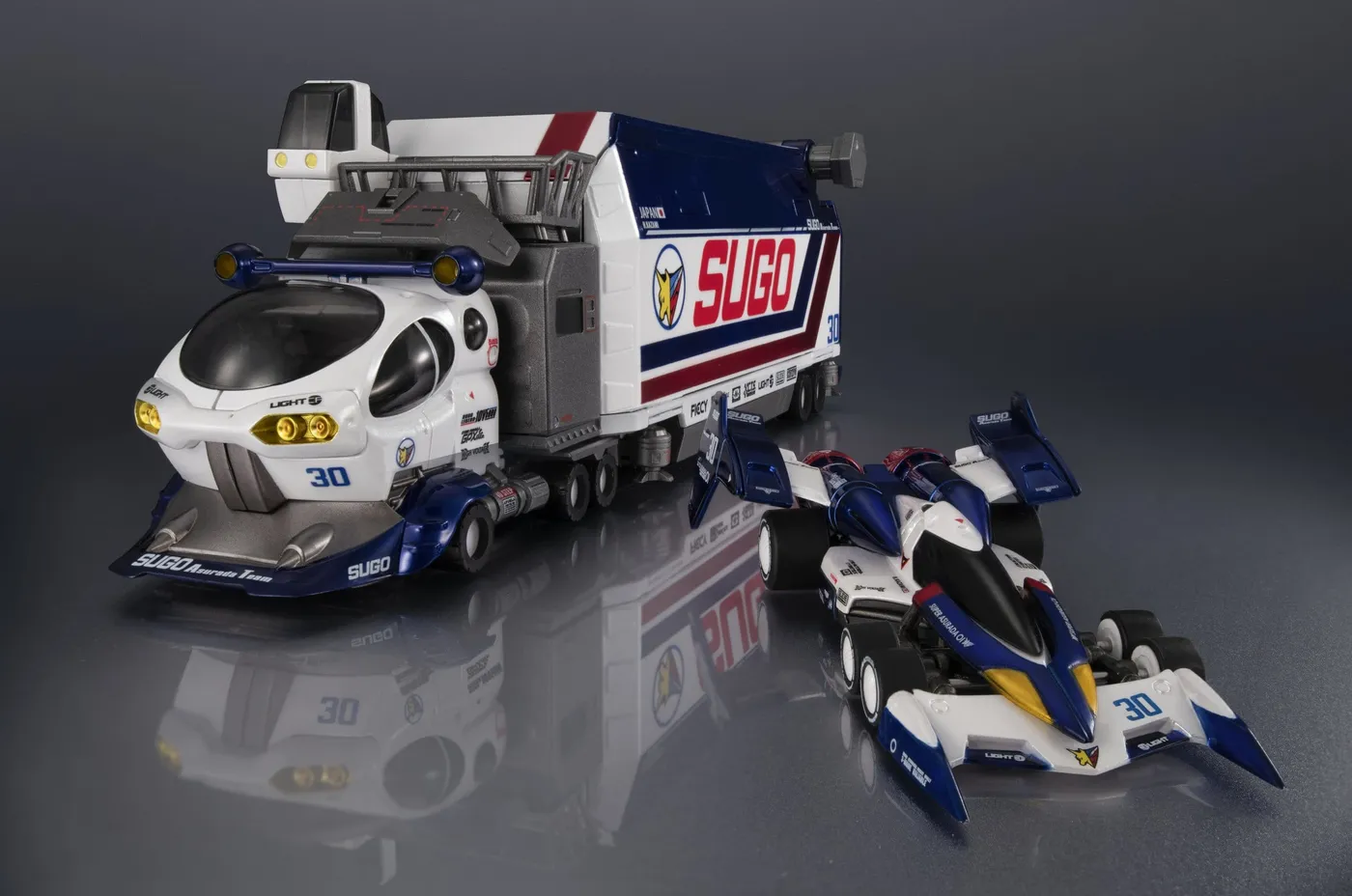
Heritage Edition also extends to larger DX sets. The Sugo Legard 10V5000 and Super Asurada 01 Circuit Mode set is about 220mm long, with a trailer that converts from transport mode into a deployed base containing a computer room, a movable crane and a rotating lift.
MegaHouse Variable Action
Variable Action is MegaHouse's mid-sized finished-model range, with Cyber Formula releases commonly around 180–200mm. Materials and mode-change engineering vary: some use replacement parts and some include die-cast components. The SAGA Garland SF-03, for example, uses swapped pieces for its boost mode. This tier gives a car substantial desk presence without reaching Hi-SPEC dimensions.
Variable Action 2ndLAP is MegaHouse's updated take on the same format. The Super Asurada SA-01/C from 11 is about 200mm long in white, blue and red. Its front wheels steer, its boost pods extend without swapping parts and its effect fans open, while replacement parts recreate Aero Mode and the deployed air brakes. It ships with a dedicated display base. The edition listed here also adds bonus acrylic stands of Hayato Kazami and Bleed Kaga with newly illustrated artwork.
MegaHouse Variable Action Hi-SPEC
Hi-SPEC is MegaHouse's premium Cyber Formula tier. Releases typically include die-cast components and more advanced transformation engineering, but the available modes and transformation method vary by product. The SIN Ogre AN-21 moves through five configurations without replacement pieces, while the 35th anniversary Super Asurada AKF-11 is around 270mm long and changes between circuit and aero modes.
Pricing generally sits above standard Variable Action, reflecting differences in size, materials and engineering. Features are not uniform here, so read the individual release rather than assuming five modes or one transformation method.
threezero threeMega
threeMega is a collaboration brand run by threezero and MegaHouse together. Variable Action Hi-SPEC United is the format it uses for Cyber Formula. It is a separate product line from threezero’s DLX, MDLX and ROBO-DOU ranges.
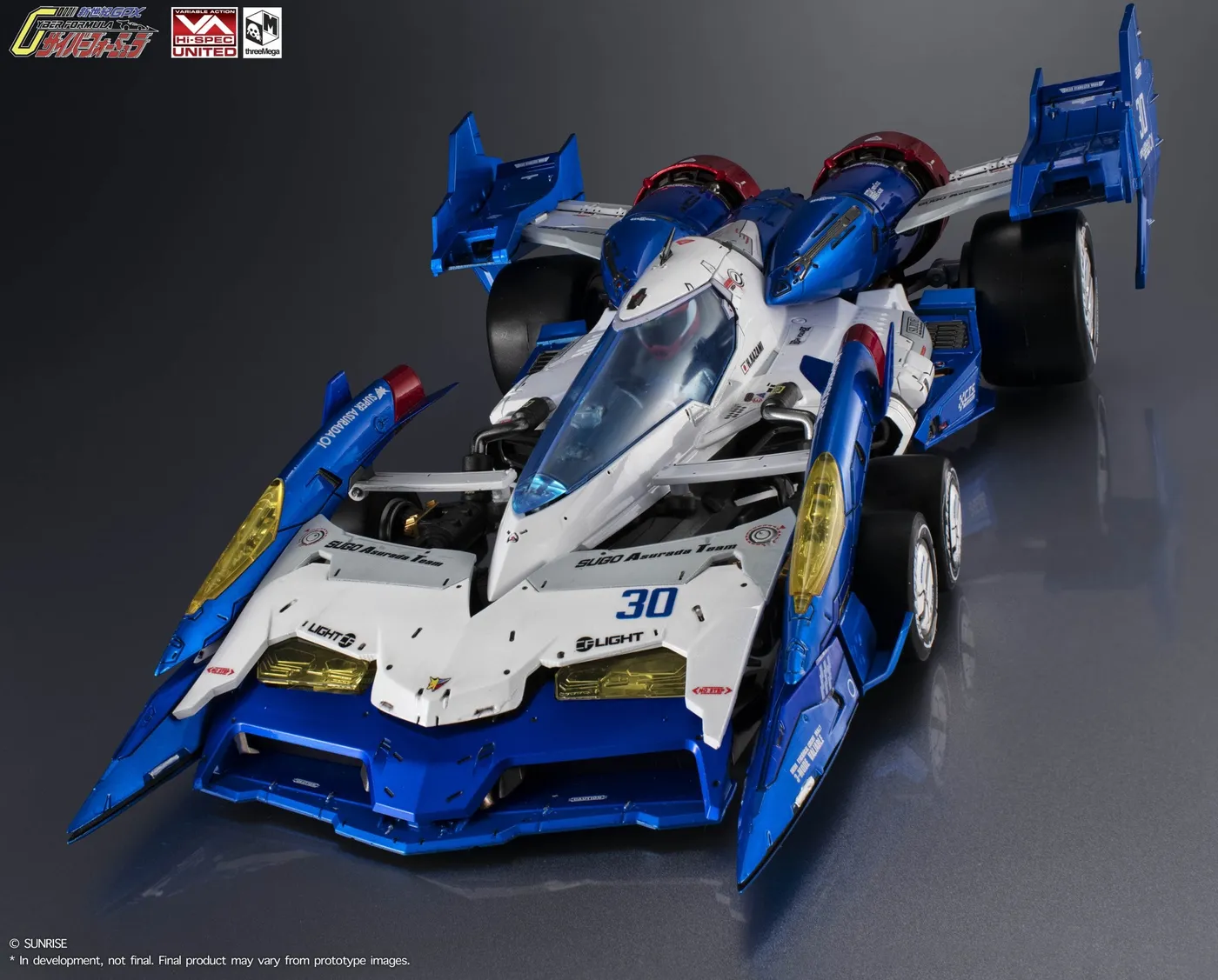
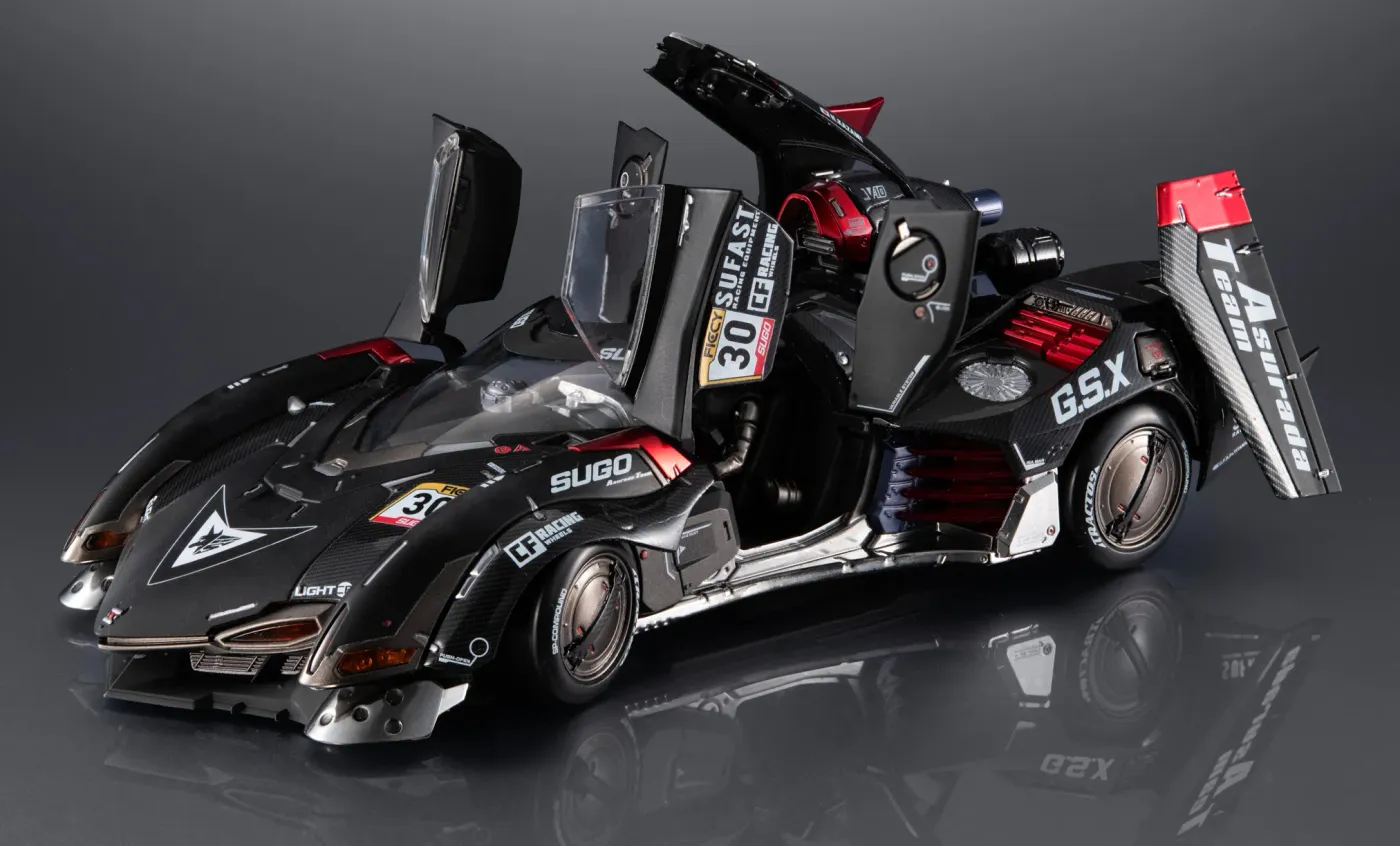
The first release, the Asurada G.S.X, set the template: a 1/18 scale die-cast model roughly 24.3cm long, built mainly from zinc alloy die-cast with POM and ABS at the moving joints, soft PVC tyres and a metallic coating. Doors, roof, fuel cover and rear hatches open, the rear wings fold and the front wheels steer. LEDs sit in the headlights, tail lights, control panel and boost pod, controlled from a display base modelled on the anime's circuit. An articulated Hayato Kazami figure fits in the cockpit.
The Asurada G.S.X RS Siren is the 35th anniversary version of that model, in matte black and red with a carbon-fibre texture. Its design references the Asurada G.S.X shakedown test. Series director Mitsuo Fukuda chose the name Siren.
The Super Asurada 01 is the second threeMega release and a different proposition again. It measures roughly 277mm long in Technical Circuit Mode and transforms fully between Technical Circuit, Aero and Rally modes. Kelvin Sau, threezero's creative director, reworked Shoji Kawamori's original shape with added surface detail. LEDs light the headlights, cockpit consoles and boost pods, a die-cast Cyber Key triggers the headlights magnetically and the display base plays soundtrack, sound effects and newly recorded Japanese dialogue from the original television cast.
Set against a 70mm Heritage Edition car, this is a different category of object: four times the length, made with die-cast and engineering plastics and built around functions the small models never attempt.
Heritage Edition, Variable Action, Hi-SPEC and threeMega compared
| Line | Typical size | Typical materials | Mode changes | Price category | Suits |
|---|---|---|---|---|---|
| MegaHouse Heritage Edition | Generally around 70mm | Small pre-painted display models; check individual specifications | Mostly fixed, with articulated parts on selected releases | Entry level | A grid of machines in very little space |
| Heritage Edition DX | Around 220mm for the Sugo Legard set | Pre-painted display set; check individual specifications | The Sugo Legard transporter converts to a deployed base | Mid range | A scene piece without premium pricing |
| MegaHouse Variable Action | Commonly around 180–200mm | Varies by release; painted plastic with die-cast components on some models | Varies; replacement parts on some releases | Mid range | An articulated car with desk presence |
| MegaHouse Variable Action Hi-SPEC | Varies by release; approximately 270mm for the AKF-11 example above | Typically painted plastic with die-cast components | Advanced transformation; modes and method vary by release | Premium | Collectors who want more advanced engineering |
| threeMega Variable Action Hi-SPEC United | Roughly 24cm to 28cm for the examples above | Varies by release; die-cast zinc alloy, POM, ABS and PVC on the examples above | Varies, from opening panels to three-mode transformation | Flagship | One centrepiece with premium materials and electronic features on selected releases |
Specifications vary between releases inside every one of these lines. Size, materials, accessories and whether a model changes modes at all are decided per product, so check the product page before ordering.
Which Cyber Formula collectible should you start with?
There is no single right entry point, so work from your own constraints.
- Limited shelf space. Heritage Edition wins outright. Several cars fit where one Variable Action model would sit.
- A modest budget. Heritage Edition again, or a Heritage Edition set if you want several machines at once.
- A favourite machine. Availability differs considerably between machines and product lines, so start from the machine and see which lines cover it.
- Transformation that works. Hi-SPEC or threeMega, then confirm which modes the release actually covers.
- Die-cast weight. Hi-SPEC and threeMega are more consistently positioned around premium engineering and metal content, while some standard Variable Action releases also include die-cast components. Heritage Edition models are generally compact display pieces, but check the exact materials for each release.
- A matching range. Stay inside one line. A Heritage Edition car next to a Hi-SPEC one reads as two unrelated objects.
The most expensive option is not automatically the right first purchase. A group of Heritage Edition machines can cover more designs in the space taken by one large model.
What to check before ordering
- Dimensions rather than photographs. A studio shot of a 70mm model and one of a 277mm model look much the same. Read the listed measurements.
- Display footprint. Bases, cases and deployed aero parts all take more room than the car alone.
- How the mode change works. Full transformation and part-swap conversion are different experiences. Both are legitimate, but know which you are buying.
- Materials. Die-cast content changes weight, feel and price. Check the individual specification rather than assuming it from the line name.
- What is in the box. Display case, display base, driver figure, stand and stickers all vary by product.
- Batteries. Lit and sound-equipped models often need cells that are not included. The threeMega RS Siren takes three AAA and three AG13.
- Scale. These lines do not share one. threeMega's Asurada G.S.X is 1/18 and the Variable Action Kit Knight Savior 005 is 1/43, while Heritage Edition scale labelling varies by release. Check each product rather than assuming similarly named machines will match.
- Preorder timing. Release windows are usually months out and manufacturers do move them.
- Prototype images. Promotional photography is often shot from a pre-production sample. Manufacturers label this, so expect small differences in the final paint.
Buying Cyber Formula collectibles in the UK
Zero Variant offers a selected range of officially licensed Cyber Formula collectibles rather than every release. The current line-up sits on the Future GPX Cyber Formula collection page, covering MegaHouse Heritage Edition and Variable Action 2ndLAP machines alongside the threeMega releases.
Ordering is UK based and UK delivery is free. Selected upcoming Cyber Formula releases are available as preorders, many of which can be reserved with a deposit rather than the full amount, with the balance taken when the item is ready to ship. A preorder can be cancelled at any point before release and anything paid is refunded. The shipping and returns page has the detail.
Zero Variant is also an official distribution partner of threezero in the UK, which is how the threeMega machines reach this catalogue.
Frequently asked questions
What is the difference between Asurada G.S.X and Super Asurada 01? They are separate chassis from the same television series. The Asurada G.S.X is Hayato Kazami's original Sugo car; later in the run, its Asurada cyber system is transferred into the Super Asurada 01. The Super Asurada 01 is not a modified G.S.X.
Are Cyber Formula models all the same scale? No. threezero's threeMega Asurada G.S.X is 1/18 and MegaHouse's Variable Action Kit Knight Savior 005 is 1/43. Heritage Edition models are generally around 70mm long, but scale labelling varies between releases, so check the individual specifications.
Do Cyber Formula collectibles transform? Some do. Heritage Edition cars are mostly fixed, some Variable Action releases change configuration through replacement parts and selected Hi-SPEC and threeMega releases offer full transformation. Check the individual product.
What is the difference between Heritage Edition and Hi-SPEC? Size, materials and function. Heritage Edition cars are generally compact pre-painted display models with a case. Hi-SPEC releases are larger, typically include die-cast components and use more advanced transformation engineering. Exact materials, modes and transformation methods vary by release.
Is threeMega part of threezero? threeMega is a collaboration brand operated by threezero together with MegaHouse. It is separate from threezero's own lines such as DLX, MDLX and ROBO-DOU.
Where can I buy Cyber Formula collectibles in the UK? Zero Variant carries a selected range of officially licensed releases on its Cyber Formula collection page, with UK ordering, free UK delivery and preorder terms set out before you commit.
Where to go next
Cyber Formula gets easier to collect once you treat Asurada as a lineage rather than one car. The line name on the box is a useful starting point for size, materials and features, but individual specifications still matter. Decide which machine you want, decide how much shelf and budget it gets, then pick the line that matches.
When you are ready, browse the Cyber Formula collection to see which machines are currently available.